



In the Summer of 2021, I bought the cheapest 1970 Karmann Ghia convertible in the world (technically the second cheapest, more on that later) with a simple goal: restore this abandoned cult-classic to absolute uncompromising perfection… with modern amenities, and a race engine. It would be a show-quality car. “Great” would be failure.
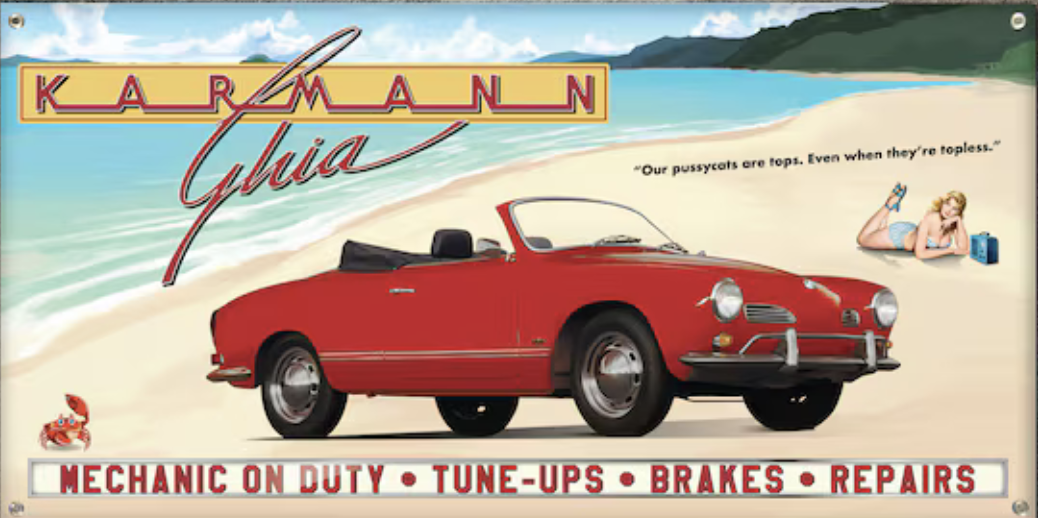
It’d be the first of many such builds in my eyes, and the fulfillment of a dream I was supposed to share with my dad twenty years earlier. I could twist a wrench, but I didn’t know how to weld or paint or fabricate or any other seemingly industrial, blue collar skills that are actually fine art when you get into them and give them their due. I figure I’d learn on the job, and gave myself a year to get it done. And because I was doing all the work myself, a $25,000 budget seemed about right.
I couldn't have been more wrong. About everything.
It starts with a failed drive deep into the Arkansas Ozarks. I say failed, but technically the drive there was a success.
I'd been searching for a Karmann Ghia convertible project car (among a few others on my bucket list) for months, and found two in the U.S. that seemed to cut the mustard for rust and distance away. One was a three hour drive to Dallas for $1,200, and the other was a ten hour drive into the Arkansas mountains for $1,000. I picked the latter and after confirming with the owner that I was coming to pick it up, rented a U-Haul trailer to drag behind the Land Cruiser.
The first seven hours of the trip were pretty easy going, mostly getting out of Texas and the dispensaries and casinos of Choctaw Nation, so I spent the time fantasizing about the car I was about to pick up. In the pictures it was sort of a creamy white and I wondered if I would keep it that shade. What interior color goes with white? Black was too simple. Maybe a caramel or chocolate. My daily online shopping dopamine drip was just starting to unkink, and I trusted my abilities to find anything I wanted to buy.
This dreaming went on and on until I hit the Ozarks, and found myself navigating muddy uphill switch backs with a one ton ballast swinging the ass of my Cruiser around. It was sort of like a rear-engined Karmann Ghia or Porsche in that way, but with none of the grace or satisfaction after a well-executed turn. After three hours of this, I arrived at the Wayout Salvage Yard and a collection of vintage VW beetles as far as you could see. They formed a gentle German economy car wave as they flowed with the topography.
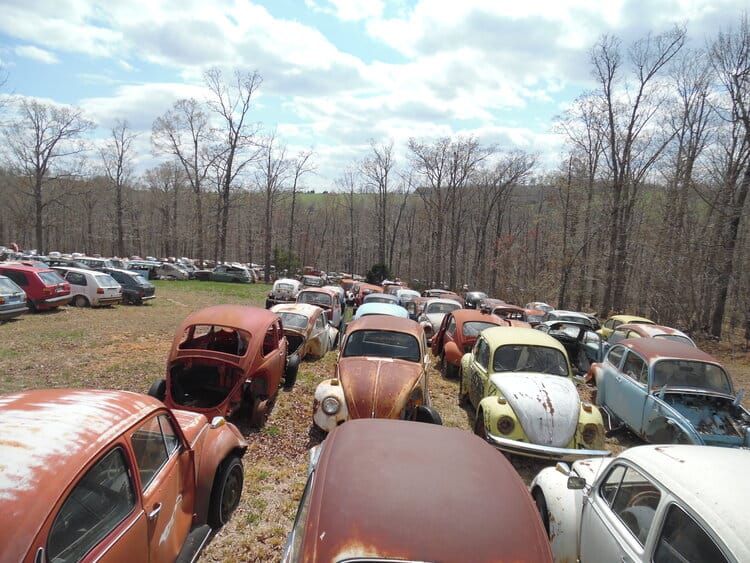
It was silent, save for the wind, and the air was damp and clean. Only occasionally, when the winds shifted, would a whiff of 50-weight oil or oxidized metal find me. I heard a weathered voice say, "Are you Aaron?" and a thin, plant-based man of about seventy-five emerged from a shack-shop and extended his hand. This was Derrick, the man I'd been speaking to about the Ghia. After a few pleasantries, he said he'd return with the car and disappeared.
I counted out ten Benjamins and waited, thinking about what I'd do first when I got it home, trying not to let the anticipation get to me. It wasn't long before I heard the high-geared wine of a forklift, and Derrick rounded the corner of his workshop with my car. When I saw it, my ears burned.
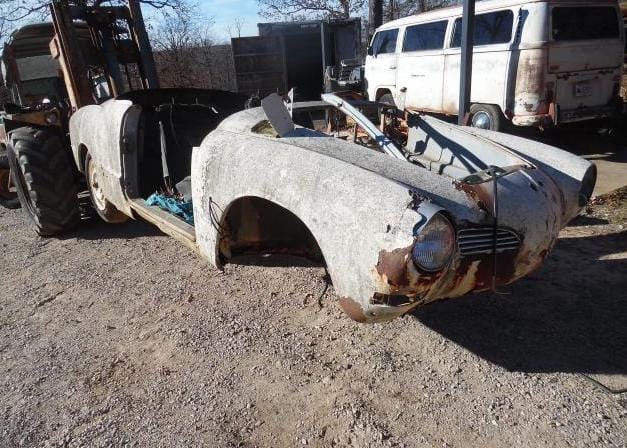
The car I saw in the pictures had wheels... doors... a windshield frame... some goddamn metal. This had none of that.
"What is this?" I said to him. He looked confused as I tried to pull up the photos from the listing on my phone, but couldn't because of the mountains blocking my signal. I abandoned the pictures and went to what was left of the Ghia. Maybe my gut reaction was overblown and I wasn't thinking like a restorer, like a confident craftsman. I went underneath the car and saw that the floorpans were patched together with wood screws and aluminum house siding — there wasn't a structural bottom anymore and the weeds and daisies were sunbathing. The cavities of the body's sides had long become fresh water tanks for the rain, rotting the German steel from the inside out. I abandoned my kneel on the soggy earth and moved to the front of the Ghia, grabbing the only headlight left... the entire front of the fender crumbled into my hand like paper mache.
"I always wanted to cut those out anyway and do a cool frenched-in headlight look," Derrick said.
I wanted to kill him.
"I can't buy this," I said, rubbing my head. He didn't say anything, only looked back at the car. I started into everything wrong with it, how it was nothing like the description, how I'd driven ten hours for nothing, how he'd wasted my time.
Derrick was quiet, shrunken. After a long silence he eked, "would you give me $500?" There were still some baked-in buyer seller negotiating neurons firing, even after the honest abuse.
I shook my head, "This is scrap." I walked back to the Land Cruiser.
For a while I leaned against the bumper, cooling off. I wasn't in a rush to get on the road and drive ten hours back home down sketchy mountain roads. Eventually I was centered and ditched my car to wander the maze of ancient beetles. I'd forgotten how small these cars were. You never really saw them anymore, even though VW made 30 million of the bastards. My high school girlfriend had one. Everybody either had one or knew someone who did. And now a thousand of them were resting here, destined either for a new life or slow death.
"Don't blame you for not wanting the Ghia," Derrick said from over the top of an orange Super Beetle. He'd slinked his way over and was keeping his distance — a man living in the mountains can't resist an ear, human or otherwise. "I'll probably just scrap it. Nothing much else I can do. Don't have the energy for projects anymore. And the family doesn't want any of this—" he waved to the mountain of cars. "It's all gotta go somehow, just hate for it to be in pieces."
I nodded, intending to leave him hanging out of spite, but I just couldn't. "How long you been up here?" I asked.
"Moved out here in '92 from upstate New York, started collecting around then," he said as he moved through the bugs, picking parts off the ground that had weathered off. "Started with uh... a dozen of these and some buses. Back then, people just gave 'em to me. It was cheaper than trying to junk 'em, I think. I bought maybe a quarter of all the rest, but didn't pay barely anything, you know. Plan was to restore some, sell some, part some. Had a bunch of the 23-window buses at one point, but those were gone by uh... by 2005 or so."
I thought about the prices of those Samba hippy buses now. Restored right they brought a buck, buck fifty, easy. Fifteen years ago Derrick probably got rid of them for a twentieth of that. He was too early and too late at the same time.
"Supposed to be my retirement, but people aren't buying parts anymore," he said with a shrug. Derrick looked off down the mountain, toward the valley I'd come from.
"Think you'll ever leave?" I asked.
He shook his head. "I lived in the city too long. I got a vegetable garden up here, some chickens, pigs. Satellite internet. Only need to go into town once or twice a month to send a package. Property taxes are $500 a year."
"That's barely two weeks of taxes in Austin," I said, laughing.
"That right?" he said with a whistle. "I don't mind paying. Kids need schools."
"That they do," I said. A familiar roof line fifty yards away caught my eye and started walking toward it, with Derrick shuffling behind me. In the weeds, nestled among piles of rusted frames, was a lime green Karmann Ghia hard top looking like an abandoned jigsaw puzzle. The only recognizable, unhacked pieces left were the roof and the passenger fender. I turned to him. "That one's seen better days."
He frowned. "That was one I was gonna restore."

We walked away from the remains back toward the house. Derrick showed me the vegetable garden, the chickens, the pigs. We chatted about climate change and mask mandates and Trump and any other happenings he could fit in while the connection was good. Everything he said was nuanced, self-aware, thoughts of an old boomer hippy who has nothing to do but think. In the early afternoon I got into the Cruiser and turned around in the expanse of his front yard, giving him a wave, seeing the remnants of the Ghia convertible on the forklift in my rearview. I wasn't upset anymore.
The trip back down the mountain was even worse, with the weight of the trailer nudging the Toyota off-balance with every turn, but I felt good. I made it to the bottom by early afternoon and my phone started its chimes and chirps once it had service again. There were the work emails and messages. I'd answer those.
There was a missed call from my mom. I wouldn't answer that.
A few hours later, in the parking lot of Choctaw Casino and Resort, I called the guy in Dallas with the second cheapest Karmann Ghia convertible in the world, the $1,200 project. "Yep, still here," he said. "When you wanna come by?"
Be sure you don't miss Part 2 (or the series) in a couple weeks.


